Первісне образотворче мистецтво: особливості розвитку в часі та просторі
Анотація
Метою даного дослідження було дослідити хронологічний розвиток первісного образотворчого мистецтва з акцентом на його регіональні відмінності. Аналіз був спрямований на вивчення художніх форм та технік різних періодів первісного мистецтва, зокрема від раннього палеоліту до неоліту, та їхнє значення для формування символічних систем. Методологія дослідження ґрунтувалася на аналізі чотирьох основних аспектів мистецтва: хронологічного розвитку художніх форм, регіональних відмінностей у техніках і стилях, застосованих матеріалах та техніках, а також символічному змісті мистецьких об'єктів. Дослідження охопило аналіз наскельних малюнків, мегалітичних споруд, різьблення по кістці та каменю, керамічних виробів, а також об'єктів, пов'язаних із символікою родючості, смерті та поховань. Результати дослідження показали, що первісне мистецтво було не лише засобом художнього вираження, але й важливим елементом релігійних та соціальних практик. Зокрема, зображення тварин відображали тотемічні вірування та ритуальні функції, а абстрактні геометричні символи мали глибоке духовне значення, пов'язане з природними циклами. Географічні відмінності вказують на різні підходи до мистецтва в регіонах: від наскельного живопису та мегалітів Західної Європи до різьблених об'єктів Східної Європи і символічних прикрас Близького Сходу. Особливу роль у ритуалах відігравали статуетки, пов'язані з культом родючості, та художні форми, що супроводжували поховання, підкреслюючи віру в життя після смерті. Таким чином, образотворче мистецтво відіграло ключову роль у відображенні духовного та соціального життя ранніх суспільств, залишаючи величезний простір для подальших досліджень, зокрема у напрямку вивчення впливу екологічних змін на розвиток символічних систем. Важливість отриманих результатів полягає у поглибленні розуміння ролі мистецтва як інструменту соціальної комунікації та ритуальної практики в ранніх суспільствах, що може бути використано в сучасних міждисциплінарних дослідженнях з археології, культурної антропології та історії мистецтва
How to Cite
Використані джерела
- A gold necklace from the time of Mesopotamia. (2023). Retrieved from https://surl.lu/jwjnxd.
- Abadía, O.M., & Porr, M. (2021). Ontologies of rock art: Images, relational approaches, and indigenous knowledges. London: Routledge.
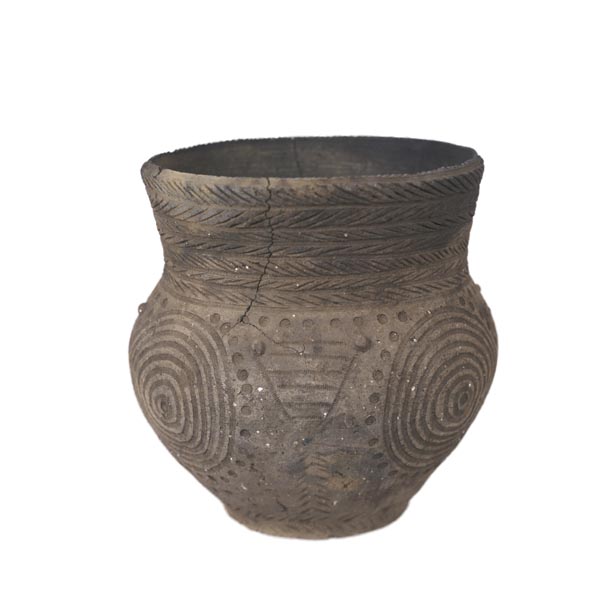
- An early clay pot with ornamentation. (2024). Retrieved from https://surl.li/lkpwoe.
- Armitage, A.R., & Bonneau, A. (2023). Rock Paintings. In Encyclopedia of geoarchaeology. Encyclopedia of earth sciences series (pp. 1-15). Cham: Springer. doi: 10.1007/978-3-030-44600-0_197-1.
- Bahn, P. (2024). Cave art: A guide to the decorated ice age caves of Europe. Oxford: Archaeopress Publishing Ltd.
- Carved stone columns, Gebekli Tepe. (2016). Retrieved from https://www.dainst.blog/the-tepe-telegrams/2016/10/14/ of-animals-and-a-headless-man-gobekli-tepe-pillar-43/.
- Ceramics of the Jomon culture. (2024). Retrieved from https://www.metmuseum.org/art/collection/search/44905.
- Davidson, I. (2023). Humans making history through continuities and discontinuities in art. Cambridge Archaeological Journal, 33(4), 37-654. doi: 10.1017/S0959774323000057.
- Davis, W. (2017). Visuality and virtuality: Images and pictures from prehistory to perspective. Princeton: Princeton University Press.
- Dolan, M. (2021). Art, architecture, and astronomy in England. In Decoding astronomy in art and architecture (pp. 6579). London: Springer. doi: 10.1007/978-3-030-76511-8_6.
- Domingo, I., & Chieli, A. (2021). Characterizing the pigments and paints of prehistoric artists. Archaeological and Anthropological Sciences, 13, article number 196. doi: 10.1007/s12520-021-01397-y.
- Drawings of hunters, rock art of the Levantine tradition. (2023). Retrieved from https://lnk.ua/7mgA8Eu3V.
- Eliade, M. (2022). Patterns in comparative religion. Lincoln: U of Nebraska Press.
- Engraved Neolithic ceramic vase. (2023). Retrieved from https://www.britannica.com/art/comb-pottery.
- Engraving in the Gorgam Cave. (2023). Retrieved from https://surl.li/vacczs.
- Fresco from Chatal-Gyuk. (2024). Retrieved from https://www.researchgate.net/figure/Catal-Hueyuekreconstructions-frescoes-way-of-life-occupations-apud_fig1_350693202.
- Gallinaro, M. (2024). Central Saharan rock art landscapes. In Landscapes and landforms of the Central Sahara. World geomorphological landscapes (pp. 207-217). Cham: Springer. doi: 10.1007/978-3-031-47160-5_22.
- Garcia-Diez, M. (2022). Chapter 13 – “Art”: Neanderthal symbolic graphic behaviour. In Updating Neanderthals. Understanding behavioural complexity in the late middle palaeolithic (pp. 251-260). London: Elsevier. doi: 10.1016/ B978-0-12-821428-2.00009-3.
- García-Diez, M., & Ochoa, B. (2020). Art origins: The emergence of graphic symbolism. In Encyclopedia of global archaeology (pp. 1-19). Cham: Springer. doi: 10.1007/978-3-319-51726-1_2819-1.
- Giedion, S. (2023). The eternal present, volume I: The beginnings of art. Princeton: Princeton University Press.
- Hidalgo Tan, N., & Hoerman, R. (2019). Mainland Southeast Asia: Rock art. In Encyclopedia of global archaeology (pp. 1-8). Cham: Springer. doi: 10.1007/978-3-319-51726-1_3127-1.
- Hunting scene, Altamira Cave. (2003). Retrieved from https://surl.li/pdgive.
- Jacobs, K. (2022). Paleolithic cave art and creativity. New-York: Yeshiva University.
- Klaus Streb, C., & Kolnberger, T. (2021). The materiality and spatiality of death, burial and commemoration. London: Routledge.
- Lorente, A.G. (2020). The origin of art: An approximation through archaeological evidences. Sociology and Anthropology, 8(3), 82-91. doi: 10.13189/sa.2020.080304.
- March, P.L. (2020). Project holocene: The clayful phenomenology of Jōmon Flame Pots. Cambridge Archaeological Journal, 31(1), 1-19. doi: 10.1017/S0959774320000189.
- Neanderthal handprints, Maltraverso Cave. (2013). Retrieved from https://zbruc.eu/node/14397.
- O’Neill, B. (2022). Treasured objects. The Journal of Irish Archaeology, 31, 41-54.
- One of the figurines of the so-called Paleolithic Venus. (2023). Retrieved from https://surl.li/musrta.
- Onions, J. (2024). Understanding rock art: What Neuroscience can add. In Deep-time images in the age of globalization. Interdisciplinary contributions to archaeology (pp. 181-192). Cham: Springer. doi: 10.1007/978-3-031-54638-9_12.
- Ozdogan, M. (2023). The epipalaeolithic and neolithic in the eastern Fertile Crescent. London: Routledge. doi: 10.4324/9781003335504.
- Robb, J. (2020). Art (pre)history: Ritual, narrative and visual culture in neolithic and bronze age Europe. Journal of Archaeological Method and Theory, 27, 454-480. doi: 10.1007/s10816-020-09471-w.
- Rozwadowski, A. (2024). “I am from here”: Rock art, heritage and identity. Heritage & Society, 18(1), 140-161. doi: 10.1080/2159032X.2023.2299651.
- Sanjuán, L.G., et al. (2020). Builders of megaliths: Society, monumentality and environment in 4th millennium cal BC antequera. Journal of Archaeological Science: Reports, 33, article number 102555. doi: 10.1016/j.jasrep.2020.102555.
- Scarre, C. (2018). Megalithic people, megalithic missionaries: The history of an idea. Estudos Arqueológicos de Oeiras, 24, 157-170.
- Spirals on Stone, Newgrange. (2013). Retrieved from https://www.carrowkeel.com/sites/boyne/newgrange4a.html.
- Stonehenge megalithic structure. (2024). Retrieved from https://www.britannica.com/topic/Stonehenge.
- Straffon, L.M. (2019). Evolution and the origins of visual art: An archaeological perspective. In Handbook of evolutionary research in archaeology (pp. 407-435). Cham: Springer. doi: 10.1007/978-3-030-11117-5_20.
- The image of a horned god in a rock painting. (2014). Retrieved from https://ericwedwards.wordpress. com/2014/07/23/the-horned-god/.
- Vandiver, P. (2022). Upper paleolithic ceramic figurines and similarities to some late pleistocene pigment and pottery materials and technologies of Eurasia. Quaternary International, 608-609, 8-32. doi: 10.1016/j.quaint.2021.06.019.
- Venus from Willendorf. (2024). Retrieved from https://www.bradshawfoundation.com/sculpture/willendorf.php.
- Zaidel, D.W. (2020). Imagination, symbolic cognition, and human evolution: The early arts facilitated group survival. In Evolutionary perspectives on imaginative culture (pp. 71-89). Cham: Springer. doi: 10.1007/978-3-030-46190-4_4.
- Zerboni, A., Villa, F., Wu, Y-L., & Solomon, T. (2022). The sustainability of rock art: Preservation and research. Sustainability, 14(10), article number 6305. doi: 10.3390/su14106305.
- Zilhão, L. (2020). The Middle Paleolithic revolution, the origins of art, and the epistemology of paleoanthropology. In The matter of prehistory: Papers in honor of Antonio Gilman Guillén (pp. 85-104). Madrid: Consejo Superior de Investigaciones Científicas.