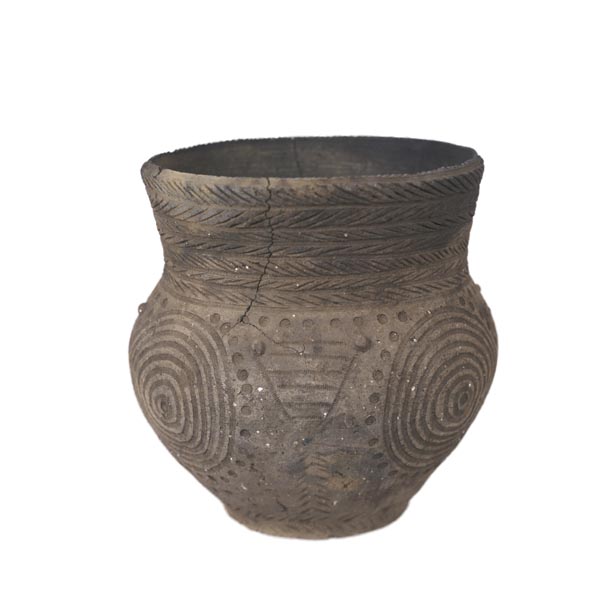
Prehistoric visual art: Characteristics of its development over time and space
Abstract
The aim of this study was to investigate the chronological development of prehistoric visual art, with a focus on its regional variations. The analysis was directed towards examining the artistic forms and techniques of various periods of prehistoric art, specifically from the Early Palaeolithic to the Neolithic, and their significance for the formation of symbolic systems. The research methodology was based on an analysis of four key aspects of art: the chronological development of artistic forms, regional differences in techniques and styles, the materials and techniques used, and the symbolic meaning of artistic objects. The study encompassed an analysis of rock art, megalithic structures, bone and stone carvings, ceramic artefacts, as well as objects associated with the symbolism of fertility, death and burials. The results of the study showed that prehistoric art was not only a means of artistic expression but also an important element of religious and social practices. In particular, depictions of animals reflected totemic beliefs and ritual functions, whilst abstract geometric symbols held deep spiritual significance linked to natural cycles. Geographical differences point to varying approaches to art across regions: from the rock art and megaliths of Western Europe to the carved objects of Eastern Europe and the symbolic ornaments of the Middle East. Figurines associated with fertility cults and artistic forms accompanying burials played a special role in rituals, emphasising the belief in life after death. Thus, the visual arts played a key role in reflecting the spiritual and social life of early societies, leaving vast scope for further research, particularly into the impact of environmental changes on the development of symbolic systems. The significance of the findings lies in deepening the understanding of the role of art as an instrument of social communication and ritual practice in early societies, which can be utilised in contemporary interdisciplinary research in archaeology, cultural anthropology and art history
How to Cite
References
- A gold necklace from the time of Mesopotamia. (2023). Retrieved from https://surl.lu/jwjnxd.
- Abadía, O.M., & Porr, M. (2021). Ontologies of rock art: Images, relational approaches, and indigenous knowledges. London: Routledge.
- An early clay pot with ornamentation. (2024). Retrieved from https://surl.li/lkpwoe.
- Armitage, A.R., & Bonneau, A. (2023). Rock Paintings. In Encyclopedia of geoarchaeology. Encyclopedia of earth sciences series (pp. 1-15). Cham: Springer. doi: 10.1007/978-3-030-44600-0_197-1.
- Bahn, P. (2024). Cave art: A guide to the decorated ice age caves of Europe. Oxford: Archaeopress Publishing Ltd.
- Carved stone columns, Gebekli Tepe. (2016). Retrieved from https://www.dainst.blog/the-tepe-telegrams/2016/10/14/ of-animals-and-a-headless-man-gobekli-tepe-pillar-43/.
- Ceramics of the Jomon culture. (2024). Retrieved from https://www.metmuseum.org/art/collection/search/44905.
- Davidson, I. (2023). Humans making history through continuities and discontinuities in art. Cambridge Archaeological Journal, 33(4), 37-654. doi: 10.1017/S0959774323000057.
- Davis, W. (2017). Visuality and virtuality: Images and pictures from prehistory to perspective. Princeton: Princeton University Press.
- Dolan, M. (2021). Art, architecture, and astronomy in England. In Decoding astronomy in art and architecture (pp. 6579). London: Springer. doi: 10.1007/978-3-030-76511-8_6.
- Domingo, I., & Chieli, A. (2021). Characterizing the pigments and paints of prehistoric artists. Archaeological and Anthropological Sciences, 13, article number 196. doi: 10.1007/s12520-021-01397-y.
- Drawings of hunters, rock art of the Levantine tradition. (2023). Retrieved from https://lnk.ua/7mgA8Eu3V.
- Eliade, M. (2022). Patterns in comparative religion. Lincoln: U of Nebraska Press.
- Engraved Neolithic ceramic vase. (2023). Retrieved from https://www.britannica.com/art/comb-pottery.
- Engraving in the Gorgam Cave. (2023). Retrieved from https://surl.li/vacczs.
- Fresco from Chatal-Gyuk. (2024). Retrieved from https://www.researchgate.net/figure/Catal-Hueyuekreconstructions-frescoes-way-of-life-occupations-apud_fig1_350693202.
- Gallinaro, M. (2024). Central Saharan rock art landscapes. In Landscapes and landforms of the Central Sahara. World geomorphological landscapes (pp. 207-217). Cham: Springer. doi: 10.1007/978-3-031-47160-5_22.
- Garcia-Diez, M. (2022). Chapter 13 – “Art”: Neanderthal symbolic graphic behaviour. In Updating Neanderthals. Understanding behavioural complexity in the late middle palaeolithic (pp. 251-260). London: Elsevier. doi: 10.1016/ B978-0-12-821428-2.00009-3.
- García-Diez, M., & Ochoa, B. (2020). Art origins: The emergence of graphic symbolism. In Encyclopedia of global archaeology (pp. 1-19). Cham: Springer. doi: 10.1007/978-3-319-51726-1_2819-1.
- Giedion, S. (2023). The eternal present, volume I: The beginnings of art. Princeton: Princeton University Press.
- Hidalgo Tan, N., & Hoerman, R. (2019). Mainland Southeast Asia: Rock art. In Encyclopedia of global archaeology (pp. 1-8). Cham: Springer. doi: 10.1007/978-3-319-51726-1_3127-1.
- Hunting scene, Altamira Cave. (2003). Retrieved from https://surl.li/pdgive.
- Jacobs, K. (2022). Paleolithic cave art and creativity. New-York: Yeshiva University.
- Klaus Streb, C., & Kolnberger, T. (2021). The materiality and spatiality of death, burial and commemoration. London: Routledge.
- Lorente, A.G. (2020). The origin of art: An approximation through archaeological evidences. Sociology and Anthropology, 8(3), 82-91. doi: 10.13189/sa.2020.080304.
- March, P.L. (2020). Project holocene: The clayful phenomenology of Jōmon Flame Pots. Cambridge Archaeological Journal, 31(1), 1-19. doi: 10.1017/S0959774320000189.
- Neanderthal handprints, Maltraverso Cave. (2013). Retrieved from https://zbruc.eu/node/14397.
- O’Neill, B. (2022). Treasured objects. The Journal of Irish Archaeology, 31, 41-54.
- One of the figurines of the so-called Paleolithic Venus. (2023). Retrieved from https://surl.li/musrta.
- Onions, J. (2024). Understanding rock art: What Neuroscience can add. In Deep-time images in the age of globalization. Interdisciplinary contributions to archaeology (pp. 181-192). Cham: Springer. doi: 10.1007/978-3-031-54638-9_12.
- Ozdogan, M. (2023). The epipalaeolithic and neolithic in the eastern Fertile Crescent. London: Routledge. doi: 10.4324/9781003335504.
- Robb, J. (2020). Art (pre)history: Ritual, narrative and visual culture in neolithic and bronze age Europe. Journal of Archaeological Method and Theory, 27, 454-480. doi: 10.1007/s10816-020-09471-w.
- Rozwadowski, A. (2024). “I am from here”: Rock art, heritage and identity. Heritage & Society, 18(1), 140-161. doi: 10.1080/2159032X.2023.2299651.
- Sanjuán, L.G., et al. (2020). Builders of megaliths: Society, monumentality and environment in 4th millennium cal BC antequera. Journal of Archaeological Science: Reports, 33, article number 102555. doi: 10.1016/j.jasrep.2020.102555.
- Scarre, C. (2018). Megalithic people, megalithic missionaries: The history of an idea. Estudos Arqueológicos de Oeiras, 24, 157-170.
- Spirals on Stone, Newgrange. (2013). Retrieved from https://www.carrowkeel.com/sites/boyne/newgrange4a.html.
- Stonehenge megalithic structure. (2024). Retrieved from https://www.britannica.com/topic/Stonehenge.
- Straffon, L.M. (2019). Evolution and the origins of visual art: An archaeological perspective. In Handbook of evolutionary research in archaeology (pp. 407-435). Cham: Springer. doi: 10.1007/978-3-030-11117-5_20.
- The image of a horned god in a rock painting. (2014). Retrieved from https://ericwedwards.wordpress. com/2014/07/23/the-horned-god/.
- Vandiver, P. (2022). Upper paleolithic ceramic figurines and similarities to some late pleistocene pigment and pottery materials and technologies of Eurasia. Quaternary International, 608-609, 8-32. doi: 10.1016/j.quaint.2021.06.019.
- Venus from Willendorf. (2024). Retrieved from https://www.bradshawfoundation.com/sculpture/willendorf.php.
- Zaidel, D.W. (2020). Imagination, symbolic cognition, and human evolution: The early arts facilitated group survival. In Evolutionary perspectives on imaginative culture (pp. 71-89). Cham: Springer. doi: 10.1007/978-3-030-46190-4_4.
- Zerboni, A., Villa, F., Wu, Y-L., & Solomon, T. (2022). The sustainability of rock art: Preservation and research. Sustainability, 14(10), article number 6305. doi: 10.3390/su14106305.
- Zilhão, L. (2020). The Middle Paleolithic revolution, the origins of art, and the epistemology of paleoanthropology. In The matter of prehistory: Papers in honor of Antonio Gilman Guillén (pp. 85-104). Madrid: Consejo Superior de Investigaciones Científicas.